Promising Invention in the Insulation Industry by Nanotechnology : Aerogel


Innovative insulation products produced with nanotechnology give signs of how much the industry will develop in the future.

Image Credit : http://graphenewholesale.com/graphene-aerogel/
Aerogel, first developed in 1931, consists of more than 90% air. Thus, aerogel becomes a highly effective insulating material from any solid material with low thermal conductivity. Developed by Aspen Aerogels and 2 to 8 times more effective than conventional insulation products, AeroGel offers the most suitable options for use in different applications by transforming it into an extremely strong, durable, thin and flexible insulating material.
Advantages of Aerogel insulation products:
  • Lowest heat transmittance compared to any industrial insulation product
  • 2 to 8 times more insulation performance than traditional methods
  • Same or better insulation performance with lower weight and less volume
  • Significant savings in operations and in cost
EXAMPLES OF AEROGEL APPLICATIONS
LNG Vessels, Storage and Transfer systems
In the growing LNG market, there are options to provide cost savings in large quantities in tankers, container systems and piping, with AeroGel's premium quality insulation. The heat per unit of measurement results in a performance penalty, which results in system and operational savings.
Building and Construction Sector
Aerogel's building and construction solutions provide the highest R-value (ultra-thin profile) and avoid heat bridges. Structural and construction solutions are increasing the energy efficiency of buildings by providing insulation at places that are not possible before.
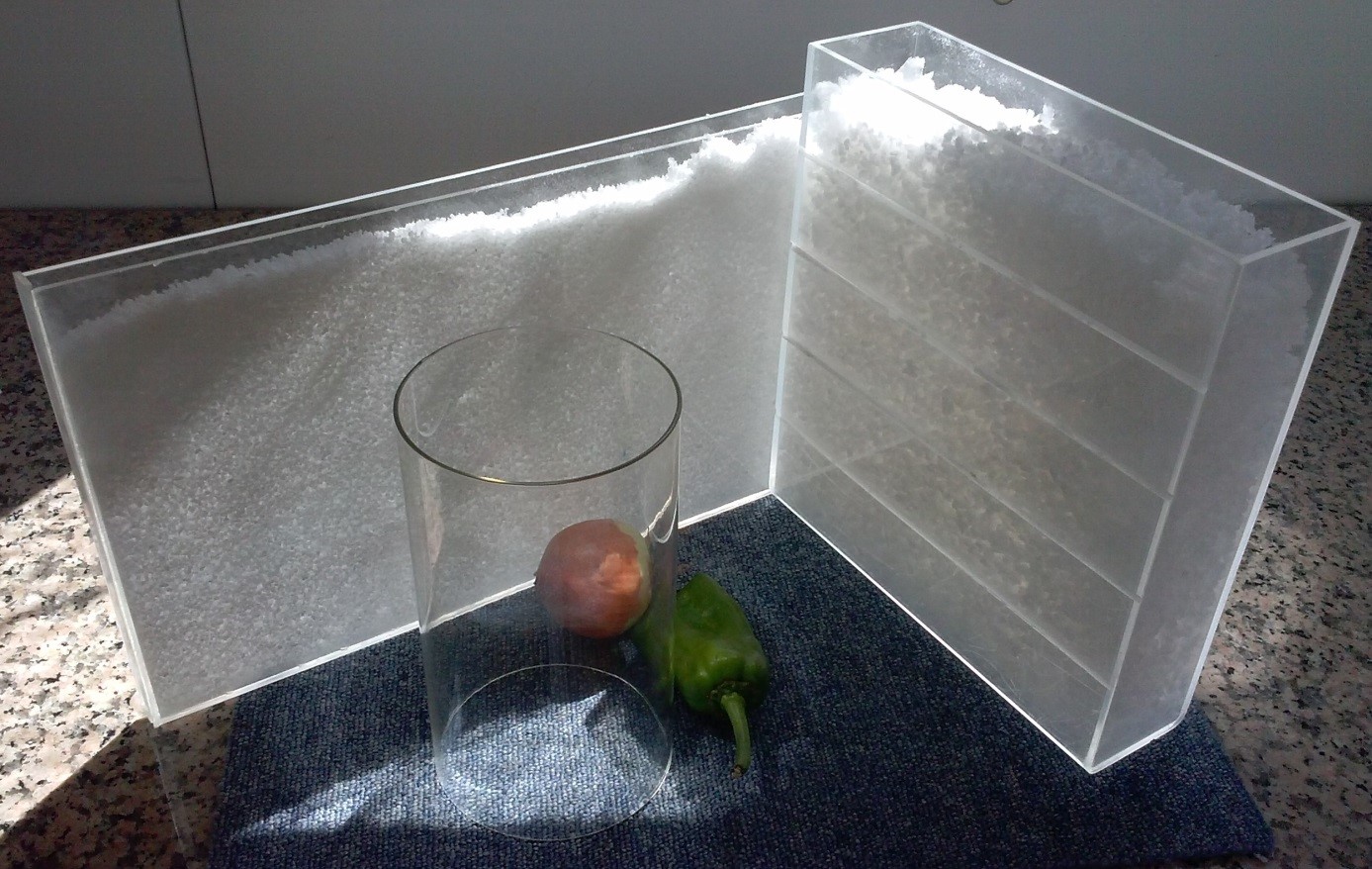
Image Credit : http://www.aerogeles.com/
Removing Petroleum from the Sea
Aerogels enables users around the world to save millions of dollars in submarine applications. Aerogel's in-pipe insulation provides equivalent or better heat performance than conventional insulation. The slim profile significantly reduces the outer pipe diameter, saving space and reducing total costs
Processing Industry
Aerogel offers superior quality insulation solutions in hydrocarbon, chemical and food processing operations. Aerogel, which is used in many areas to improve the efficiency of the pipes by reducing energy losses, contributes to saving energy and money in piping
Products
Aerogels insulation products provide maximum heat protection with minimum weight and thickness. Aerogels are offered in three product groups, Cryogel for low temperature applications, medium temperature applications Spaceloft and high temperature applications Pyrogel. The range of thicknesses available in each product range meets your needs.

Posted by

Comments

Popular posts from this blog

Usage of Silver Conductive Adhesive Paste in Corrosion Protection

In electronics, solders are main material to connect electrical components to substrates which are generally printed circuit boards. Although they are cheap, they are not effective if long term performance is considered since solders have low resistivity to corrosion relatively. Since corrosion reduce reliability, the cost of advanced technological systems such as RADAR, SONAR, LIDAR and more increase. In addition, small signals can be lost, and in huge data transfer, some of the data can be lost also especially which may lead catastrophic failures in critical systems. For instance, surface to air missiles can be launched to target which is not exist if the data coming from detection systems is noisy. Therefore, corrosion protection is necessary, and  silver conductive adhesive paste  is an essential candidate to replace PbSn solders due to its resistivity to corrosion. Silver conductive adhesive paste provide not only noisy reduction but also electromagnetic interference whi...

Reduced Graphene Oxide and Applications

Graphene oxide (GO)  is a type of graphene that contains oxygen functional groups and has some interesting properties different than those of graphene. By reducing graphene oxide,  reduced graphene oxide  is obtained which is abbreviated to rGO. In this process, the functional groups of graphene are removed but it still contains residual oxygen, hetereatoms and structural defects which decrease its quality. Having less-quality compared to pristine graphene, rGO is still an outstanding material for various applications since it resembles an attractive cost and manufacturing processes compared to the pristine graphene. Especially, it is preferred in applications that call for a large amount of material. Depending on the method of preparation of reduced graphene oxide, properties and morphology of the rGO can vary.  Some preparation methods  of reduced graphene oxide include: treating graphene oxide with hydrazine hydrate at 100°C for 24 hours exposure to h...

Differences Between Cuprous Oxide (Cu2O) and Copper (Cupric) Oxide (CuO) Nanoparticles

Copper,  which is a d block element, is named as cuprous or cupric based on the electronic configuration. The main difference between cuprous and cupric is that  cuprous is copper +1 cation  whereas cupric is copper +2 cation. When copper is reacted with oxygen, two stable compounds Cu2O and CuO form.   Copper Oxide  is the inorganic compound with the formula CuO (Figure 1) also known as  ‘cupric oxide’ . In this form, Cu is in the form of Cu+2 and the electron configuration of the Cu changes from [Ar]3d104s1 to [Ar]3d94s0. It is known as tenorite as a mineral (Figure 2). CuO can be obtained by using pyrometallurgical processes. Figure 1: Copper Oxide (CuO) Powder Cuprous Oxide  is the other stable compound of Copper with formula Cu2O. In this form, Cu is in the form of Cu+1. Its electron configuration changes from [Ar]3d104s1 to [Ar]3d104s0 so it is more stable compared to copper(II) oxide. CuO(Figure 3) is generally obtained via the oxidat...