Nanoparticles /nanopowder are of great scientific interest as they are effectively a bridge between bulk materials and atomic or molecular structures. Nanoparticles/Nanopoıwders exhibit many specific properties relative to bulk material. If you categorize nano materials; their form can be metals nanoparticles , metals&alloys nanoparticles, metal oxides nanoparticles, carbides nanoparticles, borides nanoparticles, nitrides nanoparticles, silicon nanoparticles, and other elemental semiconductors nanoparticles
The Working Mechanism
Their unique physical properties are derived from atoms on the surface. The excitation of an electron from the valance band to the conduction band creates an electron hole pair. Recombination can happen two ways as radiative and non-radiative leading to radiative recombination to photon and non-radiative recombination to phonon (lattice vibrations).
In addition, the band gap becomes increasingly larger because of quantum confinement effects giving rise to discrete energy levels, rather than a continuous band as in the corresponding bulk material. Further, problem of particle agglomeration is overcome by passivating (capping) the “bare” surface atoms with protecting groups for providing electronic stabilization to the surface. The capping agent usually takes the form of a Lewis base compound covalently bound to surface metal atoms
Some Semi-Conductor Nano Particles:
- Cadmium Sulfide(CdS) nano particles, Cadmium selenide nano particles (CdSe), Lead sulfide nano particles (PbS), Zinc sulfate nanoparticles(ZnS)
- Indium phosphide (InP) nano particles, Indium arsenide (InAs) nano particles
- titanium dioxide (TiO2) nano particles, Zinc Oxide (ZnO) nano particles, Iron Oxide (Fe2O3 )nano particles, Lead-oxide (PbO )nano particles, Yttrium Oxide( Y2O3) nano particles
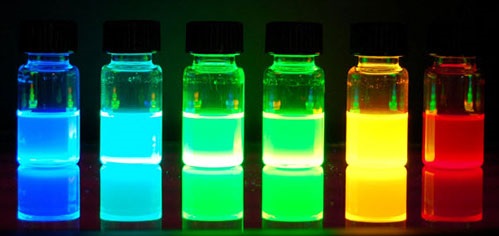
CdSxSe1-x/ZnS quantum dots of 6nm diameter
Quantum dots Nanoparticles (Q-Dots)
Semiconductor nanoparticles/nanopowder also known as Q-dots . Q-dots are nanoparticles of materials with diameters in the range of 1 to 20 nm.
Properties of Q - dots
Their electronic characteristics depending on their size and shape. Quantum Dots have high quantum yield of often 20-25 times brighter, possess a narrower and more symmetric emission spectra, 100-1000 times more stable to photo bleaching, possess high resistance to photo-/chemical degradation and have tunable wave length range of 400-4000 nm.
Applications
Quantum dots nanoparticles find applications in a number of areas such as ,nonlinear optics, luminescence, electronics, catalysis, solar energy conversion transistors, LEDs, medical imaging and quantum computing, thanks to their unique electronic properties..
http://nanoall.blogspot.com.tr/2015/04/semiconduct...
http://www.sigmaaldrich.com/technical-documents/ar...nts/ar...
http://www.washington.edu/news/2009/07/27/all-in-o...
If you want to use , buy here :
https://nanografi.com/nanoparticles/
https://nanografi.com/nanoparticles/tio2-titanium-...
https://nanografi.com/nanoparticles/tio2-titanium-...
Posted by Mehmet Basci on April 07, 2017
Comments
Post a Comment