
Strontium Titanate Nanoparticles/Nanopowder and Applications

General Information of Strontium Titanate 
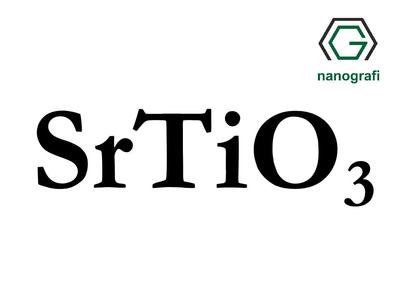
                                            
Strontium Titanate is an oxide of strontium and titanium with the chemical formula SrTiO3. It's a black powder with the melting point of 2080 oC.

Applications of Strontium Titanate Nanoparticles/Nanopowder
                                         
Strontium Titanate nanoparticles/nanopowder can be used in different electric devices. Strontium Titanate Nanoparticles/Nanopowder can be used in high density dynamic random access memories, flat panel displays, tunable resonant circuits, and soft phonon devices. In capacitors like tunable microwave capacitors and micro capacitors, Strontium Titanate nanoparticles/nanopowder can be used. For photocatalysis applications Strontium Titanate nanoparticles/nanopowder are good choices. Strontium Titanate nanoparticles/nanopowder are also used in ultra low temperature scanning microscopes.

Technical Properties of Our Strontium Titanate (SrTiO3) Nanoparticles/Nanopowder, 99.97%, 90 nm, Cubic Product
Purity %99.97
True Density (g/cm3)4,9
AVERAGE PARTICLE SIZE (nm):90
Specific Surface Area (m2/g)11,5
Melting Point (°C)2100
Morphologyspherical
Synthesis Methodhydrothermal
Sr/Ti (mol ratio)0.99-1.01


You may give an order of Strontium Titanate (SrTiO3) Nanoparticles/Nanopowder, 99.97%, 90 nm, Cubic from the link given below:

Comments

Popular posts from this blog

Molybdenum Trioxide Nanoparticles/Nanopowder and Applications

General Information about Molybdenum Trioxide                                                     Molybdenum trioxide is chemical compound with the formula MoO3. Its chief application is as an oxidation catalyst and as a raw material for the production of molybdenum metal.  Molybdenum Trioxide  is a very light blue powder. Molybdenum Trioxide Nanoparticles/Nanopowder and Their Applications                                                    Like many  nanoparticles/nanopowder , Molybdenum Trioxide nanoparticles/nanopowder are used as catalysts. These catalysis reactions include hydrogenation catalysis and cracking catalysis. Molybdenum Trioxide nanoparticles/  nanopowder are useful for...

Rundown about Silicon Oxide Wafer

The main insulating material used in micro-technology is Silicon Dioxide, which in chemical symbols is written as SiO2. In semiconductor technology, SiO2 thin film layers are mainly used as dielectric material film in transistors, capacitors (DRAM) or flash-memories. Silicon Oxide Wafers are produced using crystallization, solid state and other ultra-high purification processes such as sublimation. This process forms a cylindrical ingot, which is then sliced and polished to form wafers. Thermal oxide is a kind of "grown" oxide layer, compared to CVD deposited oxide layer, it has a higher uniformity, and higher dielectric strength, it is an excellent dielectric layer as an insulator . In most silicon- based devices, thermal oxide layer play an important role to pacify the silicon surface to act as doping barriers and as surface dielectrics. The simplest way to produce an insulating silicon oxide layers (SiO2) on silicon wafers is to oxidize silicon with oxygen, which ...

New Way of Deaf-Mute Communication with 3D Graphene

Image retrieved from: http://blogs.rsc.org/cc/2016/09/01/3d-graphene-adds-dimension-to-deaf%E2%80%93mute-communication/ Chinese scientists have developed wearable electronic device with conductive 3D graphene structure to translate sign language into written text. This technology can be applied by injecting graphene ink from a syringe under printed electronic field. For medical field, such as adhesive patches which determine heart, brain signal and neural activity, wearable and bio-integrated medical devices are very important. Due to noticeable properties of cast graphene, for example a 2D honeycomb lattice, excellent mechanical and electrical behaviors, Graphene has an important material in warble technology. However, it is difficult to preserve advantages of Graphene material in a 3D material which has an information about forces from every angle. Yanlin Song  and co-workers at the University of the Chinese Academy of Sciences, Beijing, and Shenyang Jianzhu University...