Information about Copper
Copper is a chemical element with symbol Cu and atomic number 29. It is a soft, malleable, and ductile metal with very high thermal and electrical conductivity. A freshly exposed surface of pure copper has a reddish-orange color. Copper is used as a conductor of heat and electricity, as a building material, and as a constituent of various metal alloys, such as sterling silver used in jewelry, cupronickel used to make marine hardware and coins, and constantan used in strain gauges and thermocouples for temperature measurement.
Nanoparticles/Nanopowder of Copper and Application Areas
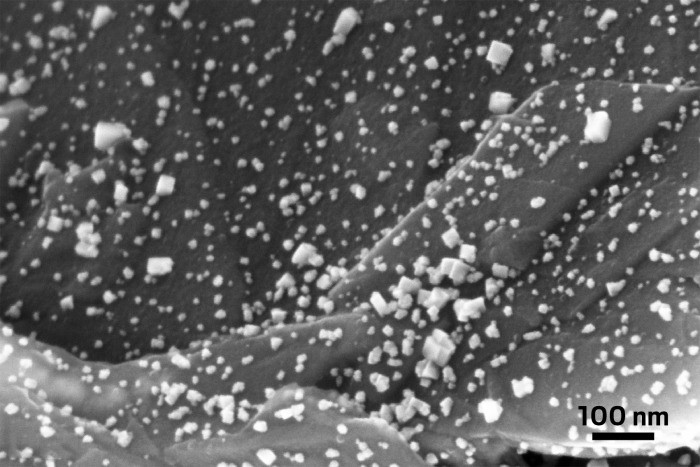
Copper Nanoparticles/Nanopowder display unique characteristics including catalytic and antifungal/antibacterial activities that are not observed in commercial copper. Copper Nanoparticles/Nanopowder demonstrate a very strong catalytic activity, a property that can be attributed to their large catalytic surface area. With the small size and great porosity, the nanoparticles/nanopowder can achieve a higher reaction yield and a shorter reaction time when utilized as reagents in organic and organometallic synthesis. Copper Nanoparticles/Nanopowder with great catalytic activities can be applied to biosensors and electrochemical sensors. Redox reactions utilized in those sensors are generally irreversible and also require high overpotentials (more energy) to run. In fact, the nanoparticles/nanopowder have the ability to make the redox reactions reversible and to lower the overpotentials when applied to the sensors. Copper nanoparticles/nanopowder that are extremely small and have a high surface to volume ratio can also serve as antifungal/antibacterial agents. The antimicrobial activity is induced by their close interaction with microbial membranes and their metal ions released in solutions. Copper Nanopowders/Nanoparticle can be used as a replacement for more expensive metals, because Copper Nanopowders/Nanoparticle are ideal for reducing production costs, and find wide usage in microelectronic processes, conductive pastes, and as nanometal lubricant and sintering additives.
Technical Properties of Our Copper (Cu) Nanoparticles/Nanopowder, 99.95%, 35 nm, metal basis Product
| Bulk Density (g/cm3): | 0,19 |
| True Density (g/cm3): | 8,9 |
| Color: | warm copper brown |
| Shape: | spherical |
| Crystal Structure: | cubic |
| AVERAGE PARTICLE SIZE (nm): | 35 |
| SPECIFIC SURFACE AREA (m2/g): | 11,0-15,0 |
You may find Copper (Cu) Nanoparticles/Nanopowder, 99.95%, 35 nm, metal basis from the link given below:
Technical Properties of our Copper (Cu) Nanoparticles/Nanopowder, 99.95%, 80nm, metal basis product
| Bulk Density (g/cm3): | 0,22 |
| True Density (g/cm3): | 8,9 |
| Color: | warm copper brown |
| Shape: | spherical |
| Crystal Structure: | cubic |
| AVERAGE PARTICLE SIZE (nm): | 100 |
| SPECIFIC SURFACE AREA (m2/g): | 5,0-5,8 |
You may find Copper (Cu) Nanoparticles/Nanopowder, 99.95%, 80nm, metal basis from the link given below:
Technical Properties of our Copper (Cu) Nanoparticles/Nanopowder 99.95%, 65nm, metal basis product
| Bulk Density (g/cm3): | 0,22 |
| True Density (g/cm3): | 8,9 |
| Color: | warm copper brown |
| Shape: | spherical |
| Crystal Structure: | cubic |
| AVERAGE PARTICLE SIZE (nm): | 65 |
| SPECIFIC SURFACE AREA (m2/g): | 6,5-7,5 |
You may find Copper (Cu) Nanoparticles/Nanopowder, 99.95%, 65nm, metal basis from the link given below:
Technical Properties of our Copper (Cu) Nanoparticles/Nanopowder, ≥99,8, 25 nm, metal basis product
| Cu Purity (%): | ≥99,8 |
| Bulk Density (g/cm3): | 0,2-0,4 |
| True Density (g/cm3): | 8,9 |
| Color: | dark brown |
| Shape: | spherical |
| Crystal Structure: | cubic |
| AVERAGE PARTICLE SIZE (nm): | 25 |
| SPECIFIC SURFACE AREA (m2/g): | 35,0-55,0 |
You may find Copper (Cu) Nanoparticles/Nanopowder Partially Passivated,99.85%, 22 nm from the link given below:
Technical Properties of our Copper (Cu) Nanoparticles/Nanopowder, 99.95%, 570 nm, metal basis product
| Bulk Density (g/cm3): | 0,7-1,1 |
| True Density (g/cm3): | 8,9 |
| Color: | reddish brown |
| Shape: | spherical |
| Crystal Structure: | cubic |
| AVERAGE PARTICLE SIZE (nm): | 570 |
| SPECIFIC SURFACE AREA (m2/g): | 4,6 |
You may find Copper (Cu) Nanoparticles/Nanopowder, 99.95%, 570 nm, metal basis from the link given below:
Technical Properties of our Copper (Cu) Nanoparticles/Nanopowder, 99.95%, 80-240 nm, metal basis product
| Bulk Density (g/cm3): | 0,25 |
| True Density (g/cm3): | 8,9 |
| Color: | reddish brown |
| Shape: | spherical |
| Crystal Structure: | cubic |
| AVERAGE PARTICLE SIZE (nm): | 80-240 |
| SPECIFIC SURFACE AREA (m2/g): | 4,6 |
You may find Copper (Cu) Nanoparticles/Nanopowder, 99.95%, 80-240 nm, metal basis from the link given below:
Technical Properties of our Copper (Cu) Nanoparticles/Nanopowder, 99.95%, 780 nm, metal basis product
| True Density (g/cm3): | 8,9 |
| Color: | reddish brown |
| Shape: | spherical-rectangular |
| Crystal Structure: | cubic |
| AVERAGE PARTICLE SIZE (nm): | 800 |
| SPECIFIC SURFACE AREA (m2/g): | 1,8 |
You may find Copper (Cu) Nanoparticles/Nanopowder 99.95%, 780 nm, metal basisfrom the link given below:
Technical Properties of our Copper (Cu) Nanoparticles/Nanopowder Carbon Coated, 99.85%, 22 nm product
| Cu Purity (%): | ≥99,85 |
| Bulk Density (g/cm3): | 0,2-0,4 |
| True Density (g/cm3): | 8,9 |
| Color: | black |
| Shape: | spherical |
| Crystal Structure: | cubic |
| AVERAGE PARTICLE SIZE (nm): | 22 |
| SPECIFIC SURFACE AREA (m2/g): | 35,0-55,0 |
You may find Copper (Cu) Nanoparticles/Nanopowder Carbon Coated, 99.85%, 22 nm from the link given below:
Comments
Post a Comment